1
/
of
2
GLA 240 - 60 Softgels
GLA060
Out of stock
Regular price
Sale price
Regular price
Unit price
/
per
Shipping calculated at checkout.
Couldn't load pickup availability
Sorry, it's out of stock.
But we can let you know when it's back in.
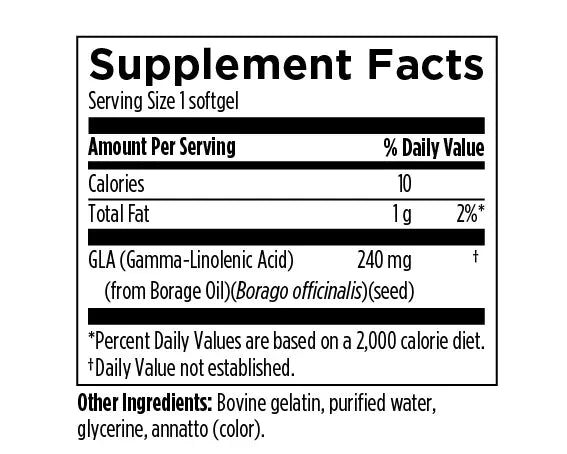
Ingredients
| 1 serving contains: | % RI* |
|---|
Other ingredients:
*RI = recommended daily intake, ✝ = RI not specified
Verifications
Verifications
Soy-free
Dosage
Dosage
Take 1 softgel per day with a meal or as directed by your health-care practitioner.
Warnings
Warnings
If you are pregnant, nursing, taking any medications, or planning any medical procedure, consult your health-care practitioner before use.
Storage
Storage
Store in a cool, dry place away from direct sunlight and heat
Description
GLA (gamma-linolenic acid) is the functional ingredient
found in the oil of borage seeds, evening primrose, and
black currant seeds. It is a fatty acid in the omega-6
category, but unlike the omega-6-heavy oils (such as
corn, soy and cottonseed oils) that predominate in
processed foods, GLA from borage oil has powerful
health-promoting effects, as it helps support a healthy
inflammatory response and female hormonal balance, and
also contributes to lustrous, healthy skin and nails.*
Maintaining a healthy balance of omega-3 and omega-6 fats in the body is important for a host of biochemical
processes. Owing to changes in the modern food supply and industrial farming practices, the modern diet is
very high in omega-6 and low in omega-3. However, omega-6 fats, in and of themselves, are not harmful. In
fact, the “parent” omega-6 fat, linoleic acid, is an essential fatty acid, meaning that we must consume it from
our diet because the human body cannot synthesize it internally. It’s not the omega-6, per se, but rather that
we are typically consuming too much of it, especially in relation to a deficit of omega-3. Even so, there are
specialized types of omega-6 fats that have specific benefits. GLA is one of them.
GLA is a precursor to dihomo-gamma-linolenic acid (DGLA), which is a building block for compounds that
help support a healthy inflammatory response. We typically think of omega-3s as possessing this role and
omega-6s as contributing to occasional inflammation, but as with most issues in health and nutrition, the
truth is a bit more complex. Both omega-3s and omega-6s can contribute to or help resolve the inflammatory
response, depending on the overall metabolic state of the body.
Linoleic acid is a precursor to GLA, but several things can interfere with the body’s ability to make this
conversion efficiently, such as insufficiencies of vitamin B6 and biotin, which are required cofactors for the
enzymes involved. Suboptimal thyroid function and elevated insulin or blood glucose may also impair this
conversion, so some individuals may benefit from getting this special fatty acid directly rather than depending
on unpredictable and inefficient metabolic pathways. The amount of GLA provided by each softgel of this
product would be difficult to get from food sources alone and may be greater than some individuals are
capable of synthesizing from linoleic acid.
Recommended Use: As a dietary supplement, take one softgel per day with a meal, or as directed by your
health care practitioner.
found in the oil of borage seeds, evening primrose, and
black currant seeds. It is a fatty acid in the omega-6
category, but unlike the omega-6-heavy oils (such as
corn, soy and cottonseed oils) that predominate in
processed foods, GLA from borage oil has powerful
health-promoting effects, as it helps support a healthy
inflammatory response and female hormonal balance, and
also contributes to lustrous, healthy skin and nails.*
Maintaining a healthy balance of omega-3 and omega-6 fats in the body is important for a host of biochemical
processes. Owing to changes in the modern food supply and industrial farming practices, the modern diet is
very high in omega-6 and low in omega-3. However, omega-6 fats, in and of themselves, are not harmful. In
fact, the “parent” omega-6 fat, linoleic acid, is an essential fatty acid, meaning that we must consume it from
our diet because the human body cannot synthesize it internally. It’s not the omega-6, per se, but rather that
we are typically consuming too much of it, especially in relation to a deficit of omega-3. Even so, there are
specialized types of omega-6 fats that have specific benefits. GLA is one of them.
GLA is a precursor to dihomo-gamma-linolenic acid (DGLA), which is a building block for compounds that
help support a healthy inflammatory response. We typically think of omega-3s as possessing this role and
omega-6s as contributing to occasional inflammation, but as with most issues in health and nutrition, the
truth is a bit more complex. Both omega-3s and omega-6s can contribute to or help resolve the inflammatory
response, depending on the overall metabolic state of the body.
Linoleic acid is a precursor to GLA, but several things can interfere with the body’s ability to make this
conversion efficiently, such as insufficiencies of vitamin B6 and biotin, which are required cofactors for the
enzymes involved. Suboptimal thyroid function and elevated insulin or blood glucose may also impair this
conversion, so some individuals may benefit from getting this special fatty acid directly rather than depending
on unpredictable and inefficient metabolic pathways. The amount of GLA provided by each softgel of this
product would be difficult to get from food sources alone and may be greater than some individuals are
capable of synthesizing from linoleic acid.
Recommended Use: As a dietary supplement, take one softgel per day with a meal, or as directed by your
health care practitioner.
Ingredients
| 1 serving contains: | % RI* |
|---|
Other ingredients:
*RI = recommended daily intake, ✝ = RI not specified